


Braiding funding from a variety of public and private sources is a strategy to expand access to service coordination and other community services in subsidized housing. By lacing together different funding sources, multiple organizations can pursue a joint or common goal to benefit a shared priority population while maintaining the specific program identity and restrictions each individual stream requires. This approach can maximize existing resources across multiple sectors. Also, coordinated funding can create efficiencies of scale and spark innovation, such as filling critical gaps across different populations, locales, or service types.
To support disability, aging, health, and housing organizations, this page includes:
- An overview of potential sources of funding for service coordination
- Case studies of braiding funding across sectors to support service coordination in subsidized housing and other services provided on campus
- Links to other technical assistance resources for braiding funding
- Case studies
-
Cross-sector partnerships enable organizations to coordinate their funding streams to achieve a shared goal. There are many ways to operationalize braiding in support of service coordination as illustrated in the two featured case studies. Each has a different strategy to operationalize braiding to support service coordination for older adults and people with disabilities.
- Seattle Housing Authority (SHA) uses a braided funding strategy with their local area agency on aging (AAA) to bring multiple partners together to offer comprehensive services to individuals. Each partner has its own funding management, oversight, and operations, but their backend coordination aligns services so individuals have seamless access.
- The Kelsey braids funding streams from multiple sources to offer service coordination to everyone in their buildings. Replicating this model is best when developers incorporate the concept at the start of the project.
Seattle Housing Authority
The Seattle Housing Authority portfolio includes SHA-owned and-managed properties that offer on-site supportive services to individuals living in units reserved for people with very low incomes, many of whom are older adults and adults with disabilities. About half of the population in SHA sites have incomes of $1,000 or less per month. SHA staff observed that many people would benefit from supportive services to stay healthy, safe, and independent in their homes, but may not seek and secure those supports without a service coordinator’s assistance.
SHA is a public housing agency with a Moving to Work designation from U.S. Department of Housing and Urban Development. Public housing agencies with this designation have greater flexibility in using federal funds and implementing locally designed programs to improve housing outcomes for low-income families.
Partnering for Service Coordination
For more than 20 years, SHA has partnered with the local AAA —Aging and Disability Services (ADS) for Seattle and King County. The partnership began when SHA and ADS co-developed a pilot to improve access to the state’s Foundational Community Supports (FCS) program. FCS is a part of Washington’s Medicaid demonstration program that provides intensive care management to people who are at risk of losing housing or need help finding housing. FCS is available to people receiving Medicaid who a) have a specific health issue, and b) fall into a specific risk category as defined by the state.
To start the pilot in several of its high-rise buildings, SHA provided initial seed funding and leveraged their partnership with ADS to facilitate a data-sharing agreement. ADS helped identify potentially eligible people based on the specific state criteria, and ADS care coordinators did initial outreach to determine if the individual wanted to learn about FCS. Enrollment was optional for residents, and care coordinators assisted interested individuals with next steps. After the pilot, SHA and ADS began expanding care coordination to additional residences.
Today, the ADS care coordination team provides a vital on-site presence for more than 4,500 people living across 52 SHA high-rise buildings. With oversight from a program manager and two supervisors, the team consists of 12 care coordinators and one lead coordinator dedicated to supporting this population. While approximately 25% of these residents receive Washington State’s Medicaid-funded long-term care services and supports (LTSS), the team’s impact extends to the entire community. By providing information and assistance to all residents, coordinators help individuals access essential services and navigate needs before they escalate into crisis.
Multiple sources of funding support the provision of care coordination and other supportive services, as shown in the table.
Funding for Care Coordination in SHA Buildings
Partner Funding Source(s) Approximate Percentage of Entire Program Costs SHA Flexible funds it receives as a Moving to Work agency. 25% ADS City of Seattle General Fund 25% Washington State’s Medicaid long-term services and supports (LTSS) system Monthly per client reimbursement 50% Other Strategies to Enhance Access to Services
To enhance housing stability through access to services, SHA developed an internal infrastructure to engage the greater Seattle community.
- Community services department grows partnerships with local organizations to increase referrals, support service coordination, and help with providing direct services to people residing in their buildings. These health and social services system partnerships align with priorities and needs in each building.
- The health-and-housing program manager is responsible for expanding the range of healthcare and supportive services available to people living in their buildings.
- A network of “community builders” supports individuals to advocate for their needs. Community builders are often peers with lived experience or backgrounds in supporting low-income older adults and people with disabilities.
- Community-based strategic planning engages housing operators and local organizations. This informal planning group discusses cross-sector trends, identifies specific issues that might affect a large percentage of people, and recommends approaches for mitigating those issues.
Impacts
In 2020, SHA and ADS analyzed data to compare receipt of LTSS in SHA buildings that have on-site ADS care coordinators with similar non-SHA buildings without on-site ADS care coordinators. Their analysis found that people living in SHA buildings are two to three times more likely to access LTSS than individuals with no access to a care coordinator.
The presence of multi-sector service providers working in partnership with SHA property staff created an opportunity to develop a cross-sector network of service providers whose activities and resources can be coordinated to meet the needs of people who are at risk of losing their SHA apartment. For example, SHA property managers host monthly portfolio meetings that include providers from the behavioral health sector, LTSS, and other nonprofits. These meetings provide a forum to coordinate responses and help staff connect people living in SHA buildings with appropriate providers.
More broadly, SHA’s years of strategic partnerships with different organizations across various funding streams expanded access to supportive and healthcare services. They currently estimate that approximately $35 million of resources flow through their buildings each year when counting workers, services, and additional supports provided to serve individuals.
The Kelsey
The Kelsey is a national nonprofit organization and affordable housing developer with a mission to advance housing solutions that create better communities for all people. Co-founded by Kelsey O’Connor, a woman with significant disabilities who passed away in 2018, The Kelsey aims to create communities where people with and without disabilities live, learn, work, play, and contribute side by side. The Kelsey also strategically engages people with disabilities on housing policies, design standards, development, and services.
The Kelsey focuses on four aspects of housing development:
- Co-development: The Kelsey finances, builds, and operates housing communities in partnership with developers of quality market-rate and affordable housing. Together, they create the initial concept and secure financing for housing design, development, and operations. This comprehensive approach ensures there are services available to anyone in the residence.
- Inclusive partner properties: The Kelsey works with existing housing properties where The Kelsey has no ownership stake or investment. They assist properties in marketing units to people with disabilities and provide housing-related services to individuals once they move in.
- Technical assistance portfolio: The Kelsey works with community-based organizations that are disability-led, that partner with people with disabilities, or that want to become involved in housing. The nonprofit also provides technical expertise to affordable housing developers and municipalities looking to build housing.
- Open-source resources: The Kelsey provides toolkits and guidelines to housing developers, designers, service providers, and funders that help infuse the perspectives of people with disabilities into their own work. This includes their design standards, which outline elements to support cross-disability access in multifamily housing (including detailed guidelines and self-certification tools). They also share resources on community engagement, resident services, financing, development, and more in their free Learn Center.
Example of The Kelsey’s Affordable, Mixed-Income, Accessible Housing
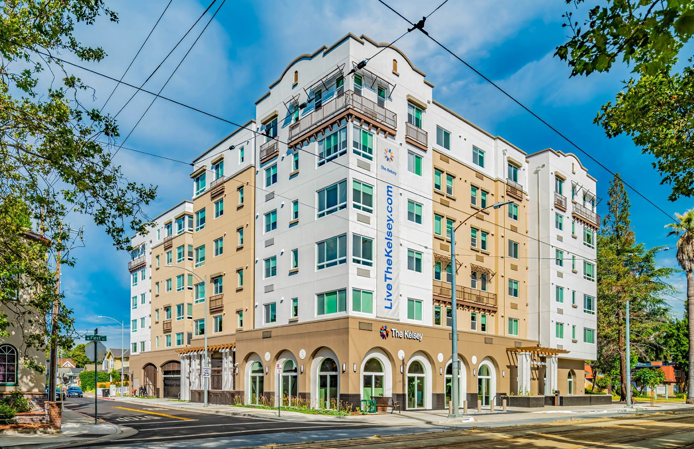
The Kelsey Ayer Station in San Jose, California, is an accessible 115-unit housing community with both two-bedroom and studio options for people with and without disabilities. This mixed-income residence leases to individuals from extremely low to moderate income (rents range from $300 to $3,000 a month based on the individual and the size of the unit). The building has shared community amenities as well as outdoor spaces to help people engage with other individuals. Twenty-five percent of the units are reserved for people with disabilities who receive home and community-based services and/or qualify for a Section 811 voucher.
The Kelsey Model
The Kelsey’s conceptual model brings affordable, mixed-income, and accessible housing together with its Inclusion Concierge program. This role cultivates community within and outside each building for individuals with and without disabilities, and this program stems from insights from focus groups of people with disabilities and their caregivers, a review of federal policies and laws, and research on best practices from existing housing for people with disabilities. Residents at The Kelsey properties have access to this concierge/service coordinator, who also functions as a program director and community connector. They meet everyone who moves in and offer to conduct an intake to understand each person’s unique needs and interests. The concierge/service coordinator works collaboratively with the individual, the property maintenance staff, the person’s natural supports (such as family and friends), and service agencies in the community. They help people with and without disabilities make community and neighbor-to-neighbor connections, build a natural support system, nurture networks of support, and connect to both paid and unpaid supports. For example, if a person would like to go to a house of worship with a friend in the building, the concierge/service coordinator can help them arrange transportation.
Concierge/Service Coordinator in Oakland Housing Partnership
In Oakland, California, a housing provider asked The Kelsey to partner and provide the concierge/service coordinator. The partnership prioritizes individuals served by the Regional Center of the East Bay and who have intellectual and development disabilities. In addition to leasing and move-in support, the concierge/service coordinator assists individuals with annual recertification for services and housing, as well as with connections to community supports and service providers, programs, and agencies.
Funding Strategies
Although The Kelsey has different funding strategies for each property, the nonprofit is committed to maintaining a sustainable concierge/service coordinator program at each building. This is possible due to large philanthropic donations ($2 million to $5 million) at the inception of each building project. Direct and in-kind funding also comes from local and state governments, foundations, corporations, and individual donors.
Integrating service coordination into the core operating budget — rather than relying on supplemental or grant-funded sources — secures a predictable, ongoing funding stream. This approach ensures long-term sustainability by treating service coordination as a core building expense. Furthermore, in certain states, specific coordination activities may be eligible for reimbursement through health coverage, which would provide an additional source of revenue.
- Additional resources on braiding funding
-
These resources provide additional information and examples of braiding federal funding.
- Bay Aging Partnerships Bring Help and Hope to People Experiencing Homelessness — Case study on leveraging resources from multiple sources to address homelessness through an area agency on aging’s multiple partnerships and convening role that supports community-wide coordination and alignment of efforts
- Blending and Braiding Reference Activities/Interventions — Lists of interventions for whole-person health needs that care coordinators can help secure, arranged in topical sections (housing insecurity, assistance with activities of daily living, transportation insecurity, access to medications or health services, and interpersonal violence)
- Braiding Resources to Collaboratively Develop and Strengthen Housing + Services Partnerships — HSRC webinar recording with examples of collaborations that combine rental assistance and access to supportive services
- Coordinating Council on Access and Mobility (CCAM) Federal Fund Braiding Guide — CCAM resource defining federal fund braiding for local match and program eligibility to enable federal agencies and federal grant recipients to more effectively manage federal funds and coordinate human service transportation
- Examining the Use of Braided Funding for Substance Use Disorder Services — SAMHSA report on state and federal laws and policies that encourage braided funding to provide substance use disorder services, best practices for braiding funds, and pathways to sustainability for substance use disorder programs
- Financing Peer Crisis Respites in the United States — SAMHSA report on the benefits of peer crisis respites within the recovery-oriented continuum of crisis care and on their common components, operations, and funding
- Financing Peer Recovery Support: Opportunities to Enhance the Substance Use Disorder Peer Workforce — SAMHSA report on the financing, utilization, and regulatory structures of providing peer recovery support
- Recovery Housing: Funding Sources and Financial Sustainability – Insights from NARR-Certified Recovery Residences — SAMHSA report on strategies and funding mechanisms to sustain recovery housing
- Select funding sources for housing and service coordination
-
Funding for housing comes from several different vehicles. Some of the most common are U.S. Department of Housing and Urban Development (HUD) Section 202 Supportive Housing for the Elderly, Section 811 Supportive Housing for Persons With Disabilities, and other HUD programs that public housing authorities manage: Section 8 Housing Choice Vouchers, Section 8 Project-Based Rental Assistance, and other vouchers. Also, the main federal tax incentive program, the Low-Income Housing Tax Credit, is primarily administered by state housing finance agencies. State and local governments may also have housing programs with funding,
The table below outlines how different types of funding for housing are operationalized. Understanding these differences is critical for effective braiding and budgeting. For this section's multi-sector audience, this table uses "individual" instead of program-specific terms such as "tenants."
Considerations for Different Funding Stream Types
Type of Funding Definition Considerations Property-based funding Funding is tied to the building to serve people living there Housing operators are able to build service coordination costs into their operating budget. Individual-based funding Funding is tied to the individual (e.g., Housing Choice vouchers) Funding for an individual’s housing needs is not an entitlement like some services (i.e., Medicare). These vouchers offer individuals more choice and control in where they want to live but are also often limited in supply.